
10 Easy Home Exercises That Require No Equipment
“I don’t have time to get to the gym” is one of the most common reasons people give for skipping exercise altogether — and it’s usually followed by the assumption that without a gym, there’s not much worth doing. That assumption is wrong.
Your own body weight is genuinely enough resistance to build strength, improve endurance, and stay consistent, especially if you’re new to exercise or coming back after a break. No dumbbells, no machines, no subscription required — just floor space roughly the size of a yoga mat.
Below are 10 exercises that cover your whole body, along with how to do them correctly and how to put them together into an actual routine.
Why Bodyweight Exercises Work
It’s a common misconception that you need external weight to build real strength. In reality, your body weight provides plenty of resistance for beginners and intermediate exercisers alike — a single push-up moves roughly 60-70% of your body weight, which is a meaningful load for most people starting out.
Bodyweight training also teaches control and coordination that weighted exercises sometimes skip past, since you’re managing your entire body through space rather than just moving an external object. That carries over directly into daily movement — getting up off the floor, carrying groceries, climbing stairs without getting winded.
1. Bodyweight Squats
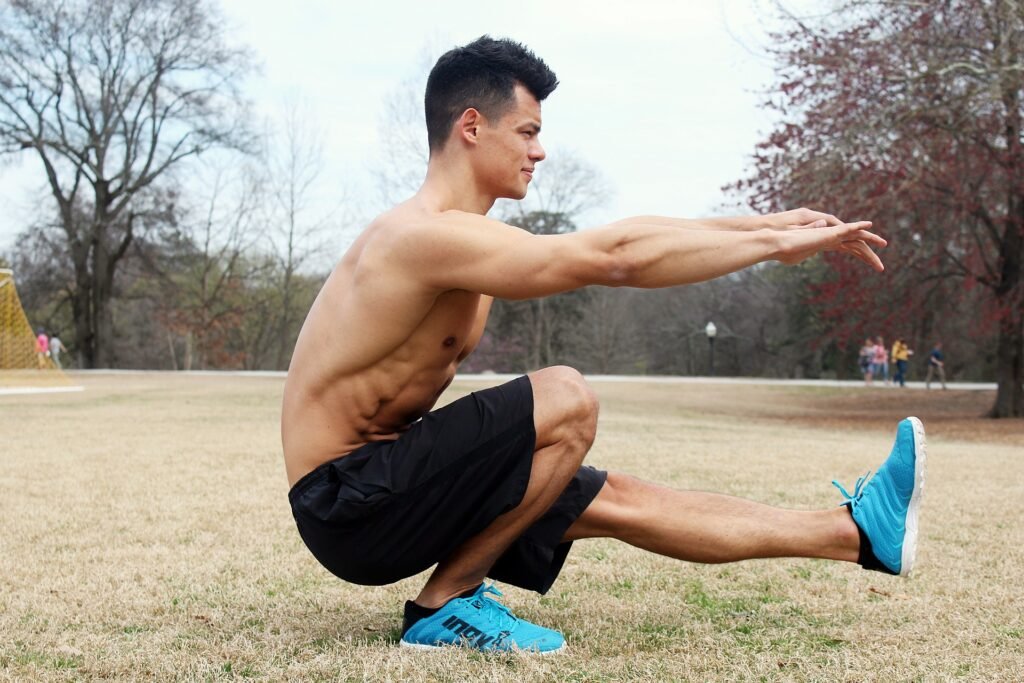
Targets: legs, glutes
Stand with feet shoulder-width apart, then lower your hips back and down as if sitting into a chair, keeping your chest up and knees tracking over your toes. Go as low as comfortable — ideally thighs parallel to the floor — then push through your heels to stand.
Squats are the foundation of lower-body strength and translate directly to real-life movement, from sitting down to lifting objects off the ground.
Start with: 3 sets of 10-15 reps
2. Push-Ups
Targets: chest, shoulders, triceps, core
Hands slightly wider than shoulder-width, body in a straight line from head to heels, lower your chest toward the floor with elbows at roughly a 45-degree angle, then push back up. If a full push-up is too difficult at first, drop to your knees or push against a wall or elevated surface to reduce the resistance.
Push-ups build upper-body pushing strength while also engaging your core to keep your body straight throughout the movement.
Start with: 3 sets of 8-12 reps (or as many as you can with good form)
3. Walking Lunges
Targets: legs, glutes, balance
Step forward into a lunge, lowering your back knee toward the floor while keeping your front knee over your ankle, then push off to step into the next lunge with the opposite leg. Keep your torso upright throughout.
Lunges add a balance and coordination challenge that squats alone don’t, which makes them especially useful for functional, everyday strength.
Start with: 3 sets of 10 lunges per leg
4. Plank
Targets: core, shoulders
Forearms on the floor, body in a straight line from head to heels, core braced as if you’re about to be poked in the stomach. Hold the position without letting your hips sag or pike upward.
The plank builds core stability, which supports nearly every other movement your body makes and is one of the most effective, low-injury-risk ways to strengthen your midsection.
Start with: 3 sets of 20-30 second holds
5. Glute Bridges
Targets: glutes, hamstrings, lower back
Lie on your back, knees bent, feet flat on the floor hip-width apart. Push through your heels to lift your hips until your body forms a straight line from shoulders to knees, squeeze your glutes at the top, then lower with control.
This is a particularly useful exercise for anyone who sits for long periods during the day, since it directly counteracts the glute weakness that prolonged sitting tends to cause.
Start with: 3 sets of 12-15 reps
6. Mountain Climbers
Targets: core, cardio conditioning
Start in a push-up position, then drive one knee toward your chest and quickly switch legs in a running motion, keeping your hips low and core engaged throughout.
Mountain climbers combine core work with an elevated heart rate, making them a useful bridge between strength training and cardio when you’re short on time.
Start with: 3 sets of 20-30 seconds

7. Tricep Dips (Using a Chair or Couch Edge)
Targets: triceps, shoulders
Sit on the edge of a sturdy chair or couch, hands gripping the edge beside your hips, feet forward. Lower your body by bending your elbows until they reach roughly 90 degrees, then push back up.
This exercise repurposes furniture most people already own into effective resistance equipment, no gym required.
Start with: 3 sets of 10-12 reps
8. Superman Hold
Targets: lower back, glutes
Lie face down, arms extended overhead. Simultaneously lift your arms, chest, and legs a few inches off the floor, squeezing your lower back and glutes, then hold before lowering.
This exercise strengthens the muscles along your spine that often get neglected in favor of ab-focused core work, which can contribute to a more balanced, injury-resistant core overall.
Start with: 3 sets of 10-15 second holds
9. Standing Calf Raises
Targets: calves
Stand with feet hip-width apart, near a wall for balance if needed. Rise onto the balls of your feet as high as possible, hold briefly, then lower with control.
Calves are easy to neglect in a bodyweight routine, but they play a real role in ankle stability, balance, and lower-leg endurance for walking or running.
Start with: 3 sets of 15-20 reps
10. Bird Dog
Targets: core, balance, lower back
Start on hands and knees. Extend one arm forward and the opposite leg back simultaneously, keeping your hips and shoulders level, hold briefly, then return and switch sides.
This is a favorite in physical therapy settings for good reason — it builds core stability and balance without any spinal loading, making it a safe option for almost anyone, including those returning from a back issue.
Start with: 3 sets of 8-10 reps per side
How to Put These Together Into a Routine
You don’t need to do all 10 exercises every session. A simple, effective approach: pick 6-7 exercises that cover your whole body (legs, push, core, and balance) and rotate through them two to three times a week.
Sample Routine (repeat the circuit 3 times, resting 60 seconds between exercises):
- Bodyweight squats — 15 reps
- Push-ups — 10 reps
- Walking lunges — 10 per leg
- Plank — 30 seconds
- Glute bridges — 15 reps
- Bird dog — 8 per side
This takes about 25-30 minutes including rest, and touches every major movement pattern without needing a single piece of equipment.
Common Mistakes With Bodyweight Training
Rushing through reps. Momentum can make bodyweight exercises feel easier than they should, which reduces how effectively your muscles are actually working. Slower, controlled reps build more strength than fast, sloppy ones.
Assuming bodyweight training has no progression. You can absolutely make these harder over time — slower tempo, added reps, single-leg variations, or reduced rest between sets all increase the challenge without needing weights.
Skipping warm-up because “it’s just bodyweight.” Cold muscles are cold muscles regardless of what’s providing the resistance. A few minutes of light movement before starting still meaningfully reduces strain risk.
Frequently Asked Questions
Can you build muscle with bodyweight exercises alone? Yes, particularly for beginners and intermediate exercisers. Your body weight provides sufficient resistance for meaningful strength and muscle gains, especially when you progress the difficulty through tempo, reps, or single-limb variations over time.
How often should I do home workouts with no equipment? Two to three times a week, with rest days in between, is a solid starting frequency, giving your muscles time to recover and adapt between sessions.
Are bodyweight exercises as effective as weights? For beginners, bodyweight training can be just as effective for building initial strength and muscle. As you get stronger, added external weight becomes more useful for continued progress, since bodyweight alone eventually stops providing enough resistance to keep challenging more advanced muscles.
What is the best no-equipment exercise for beginners? Bodyweight squats are often considered the best starting point, since they build lower-body strength efficiently and translate directly to everyday movements like sitting, standing, and climbing stairs.
How long should a no-equipment home workout be? 25 to 30 minutes is enough time to work through a full-body circuit effectively, including brief rest periods between exercises. Consistency over time matters more than the length of any single session.
Key Takeaways
You don’t need a gym membership or a rack of dumbbells to build real strength — a handful of well-chosen bodyweight exercises, done consistently two to three times a week, cover your whole body effectively. Focus on controlled form over speed, and progress the difficulty as these start to feel easier.
If you eventually want to add resistance for continued progress, a beginner strength training guide is a useful next step — and if you’re managing an existing injury, checking in with a doctor or physical therapist before starting is a reasonable precaution.